

From space to AI, Day of Climate returns to explore the frontiers of climate innovation
Veteran astronaut Sunita “Suni” Williams, whose 2024 eight-day test flight of the Boeing Starliner was expanded to a more than nine-month space mission, has had ample opportunities to view Earth from space. This vantagepoint has allowed her to observe firsthand how our planet is being affected by climate change.
“When you really start looking at our Earth, you can see that it is a system. The different parts of the Earth work together — they’re interactive,” said Williams, who was the first astronaut to run a marathon in space and recently ran the Boston Marathon. “It's amazing to be able to watch, and you realize it's not just a rock. It's really alive. You can see fields changing all throughout the middle part of the Earth. You can see deserts getting bigger. You can see glaciers getting smaller.”
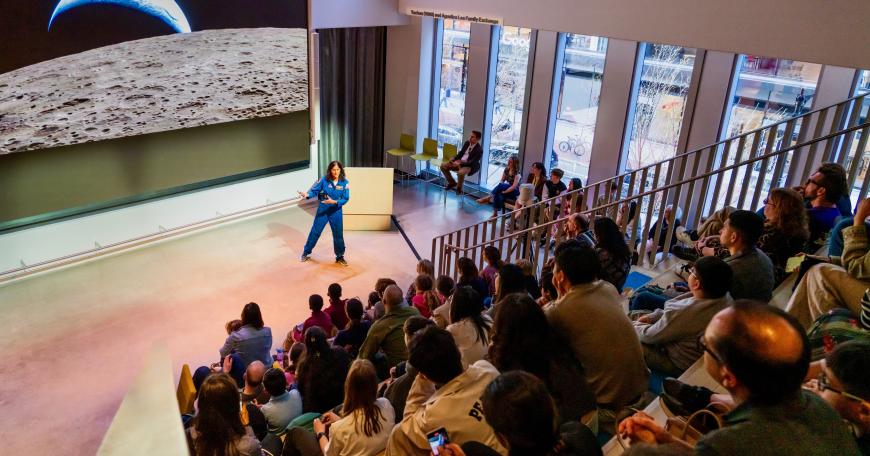
Williams recently spoke to a standing-room-only audience of all ages at the MIT Museum as part of the second annual Day of Climate. Featuring hands-on activities for young learners, talks from leading climate voices such as Williams and MIT’s Sara Beery, and interactive experiences showcasing innovative climate work from across the Institute, the event sparked hands-on learning and inspired climate action and collaboration.
“Three words come to mind today: Urgent. Collective. Actionable,” Claudia Urrea, executive director for the MIT pK-12 Initiative at Open Learning, said in her opening remarks. “They capture exactly why we are here and why this work matters so deeply.”
The event, which brought together learners, educators, activists, researchers, and families to spotlight the creativity, leadership, and real-world impact driving climate action, also marked the celebration of a larger initiative by the same name. Led by the pK-12 team at MIT Open Learning, Day of Climate brings together learners and educators, providing a free, adaptable, project-based curriculum designed to teach about climate change. The event also featured a student panel including Ananda Santos Figueiredo (’25, TPP ’27), Jacqueline Prawira (’26), and Rylan Workman (a senior at Salem High School).
Curiosity and collaboration
Introduced by Apollo Program Professor Dava Newman, Williams shared images, stories, and perspectives from her experiences as an astronaut.
“A lot of people here may know me as the person who was ‘stuck in space’ or the person with the ‘crazy hair’ in space,” said Williams. “But actually, I got to do a lot of fun stuff.”
For Williams, the summer of 2024 was a fortunate time to be in space, with especially visible aurora to observe. She said wanted to see the Red Sox play that summer, and showed an image from space that includes a zoomed-in view including Fenway Park.
Williams was always interested in science, and still remembers the science teachers who inspired her when she was a child, including a sixth-grade teacher who led the class in dissecting squid and then frying calamari. She said that her relentless curiosity and her drive to always wanting to understand how things work led her to new experiences and discoveries throughout her career.
“We all want to know how things work, and that curiosity can lead us to try new things,” said Williams.
She mentioned the example of the Astrobee project, robots designed to help astronauts with daily chores, with potential applications to grab space debris and clean up the space environment for future rockets and satellites.
While Williams brought to her space missions her vast experience as a U.S. Navy helicopter pilot, other members of the team had different backgrounds — bringing distinct skills and areas of expertise. She emphasized that a key element of being on a space mission is being a team player, a good communicator, and being able to help however needed in the day-to-day tasks. She had the opportunity to interview astronauts for the recent Artemis II lunar mission, and looked for crew members who could work well as part of a team.
“It’s the team that’s really important, and it’s the team that’s going to accomplish the amazing challenges,” says Williams. “Some things may not work out the way you expect, but what’s important is having curiosity and being able to work with others. A situation may not be ideal, but you can make the best of it, learn something, and pass that on.”
Using AI to save species
Sara Beery, assistant professor of AI and decision making in MIT’s Department of Electrical Engineering and Computer Science, also spoke about applying curiosity and collaboration to address changes in ecosystems stemming from a variety of causes, including climate change. Her research uses machine learning to analyze image datasets, allowing researchers to detect patterns in wildlife populations for which we previously had little to no data. She sees technology as a powerful tool toward maintaining the critical biodiversity that is often impacted by climate change.
“Imagine that you're a doctor and you're trying to save the life of a patient, but you can only see about a fifth of their body — so you can imagine it's difficult to try to intervene,” said Beery. “This is kind of the situation we're in with nature across the planet. We need to act now, but there's so much that we don't understand about life on Earth.”
Beery explained that scientists estimate that we share the planet with close to 10 million species, but we've only ever collected even a single record of two million of those — leaving 80% of life on Earth unrecorded. Without valuable information about different species, scientists are unable to know important details, including what they need to survive. Beery provided the example of the Tapanuli orangutan, one of only three species of orangutan on Earth, which was discovered in 2017.
“This is incredibly recent, and by the time we discovered it, it was already critically endangered,” said Beery. “We're losing species at a faster rate than we can protect them, and that is really frightening. And it's not just species that we're losing, we're also losing populations. The estimate is that we've lost 70% of all wildlife on Earth since 1970.”
Beery explained how AI can allow scientists to collect a “treasure trove” of information from people around the world, such as via the citizen science platform iNaturalist. Volunteers from around the world can photograph the natural environment around them and upload with the iNaturalist app. In the Global and Biodiversity Information Facility, there are now 300 million species observations that have been collected by volunteers.
“More than half of all of the biodiversity that we've ever collected on Earth is coming from just people taking photos of what they see around them,” said Beery. “Every single one of these images gets identified with a species, and there's so much more information captured in the pixels than just species alone.”
Previously, it would take an ecologist decades of working full-time to look through 300 million images one by one, but machine-learning technologies can completely change how these images can be used. AI models can be trained to identify particular things a researcher might be looking for to answer specific questions. Beery’s team is working towards developing a system that helps ecologists to quickly ask questions, discover information, and then analyze it efficiently using the relevant data from a huge set of images.
“It's really exciting to recognize that the future of biodiversity might not just live in remote rainforests or deep ocean trenches,” said Beery. “It actually lives with all of us, and everyone can contribute and be a piece of the puzzle working to solve the biodiversity crisis.”
At Day of Climate, one message resonated throughout: confronting the climate crisis requires cross-disciplinary curiosity, intergenerational collaboration, and action grounded in real-world impact.
Learn more and explore the Day of Climate curriculum on their website.