

A collaboration to strengthen public knowledge
A new effort between Wikipedia and MIT Open Learning promises to strengthen the credibility of publicly available knowledge.
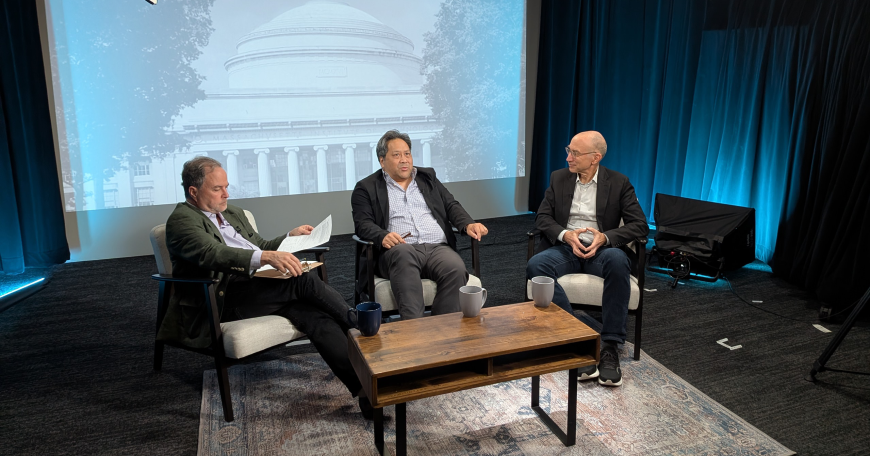
In the recent conversation “Wikipedia & MIT Open Learning: A New Strategic Collaboration,” OpenCourseWare Director Curt Newton, Open Learning Associate Director of Development Peter B. Kaufman, and Wikipedian Andrew Lih shared how the two organizations are teaming up to leverage open educational resources to advance trustworthy public knowledge in the AI era.
“I think it's just perfect that we're working together in bringing knowledge to the world in ways that are uniquely suited to this new way that we are learning and accessing content online,” said Lih.
Newton, Kaufman, and Lih’s talk is part of MIT Open Learning’s Open Conversation series, which highlights the global impact of MIT’s free and open educational resources. Their collaboration explores new ways to integrate MIT’s curricular materials into related Wikipedia entries to produce a more robust and complete reference on numerous subjects, including engineering, social sciences, mathematics, and literature to name a few.
Two pioneers of public knowledge
MIT OpenCourseWare, part of MIT Open Learning, and Wikipedia, which both launched 25 years ago, are recognized pioneers in open education and knowledge-sharing.
Wikipedia is a free, web-based encyclopedia written and maintained by a global community of more than 260,000 active volunteer editors known as Wikipedians. Driven to make knowledge available to everyone in the world, Wikipedians write, edit, fact-check, and cite sources to verify the accuracy of an article. There are more than seven million articles — and that’s just on the English version of Wikipedia, which receives about 4,500 page views every second. There are 348 active editions of Wikipedia in languages other than English. As the world’s leading reference website, its content has enhanced Google Search results and now underpins the large language models which drive generative AI.
MIT Open Learning’s OpenCourseWare publishes, shares, and distributes the materials used in MIT classrooms, freely and openly under a Creative Commons license. The license enables anyone to use, reuse, mix, and distribute the MIT content for non-commercial purposes, as long as MIT and its authors are attributed and any resulting content is also openly shared. To date, OpenCourseWare publishes resources from more than 2,590 MIT courses.
“As much as we think [Wikipedia’s] a great resource — it's the number one reference site — it's quite open in saying, we could use some help here,” said Lih, noting the Wikipedia community’s passion for getting content right. “It's those situations where we can very quickly and programmatically go through and find out what articles are high-impact, but have a high need for improvement. [K]nowing the corpus of what MIT has with OCW, [we can] find ways to connect those two, which we call matchmaking.”
Using AI as a tool for good
MIT OpenCourseWare resources are also available on MIT Learn, the new AI-enabled platform for all of MIT’s non-degree online learning opportunities. “On the docket now is a concerted effort to think about how to customize and personalize both courseware and the learning journey,” Kaufman said, describing the AI features currently in development for the platform, such as real-time translations and a tutor that supports learners by identifying areas for improvement. “How is AI affecting Wikipedia?” is an important question. “But how is AI affecting OpenCourseWare?” he asked.
For Lih, AI embeddings, or numerical representations of real-world objects like Wikipedia articles and OpenCourseWare resources, have helped to scale the work of identifying overlaps in content. But as Newton noted, “The AI tools are not making the final decisions in any way. [T]hey're taking us from these two enormous piles of information, what Wikipedia needs and what OpenCourseWare has got, and doing some really helpful initial matchmaking.”
“We're not using AI to edit Wikipedia at all. We're trying to use it to find the opportunities better,” Lih added, explaining that, ultimately, “It's going to take human insight to actually make some of those decisions.”
Once overlaps have been identified, a simple yet effective approach to connecting content would be adding an external link or reference to a Wikipedia page that points directly to corresponding OpenCourseWare lectures or resources. That way, people can easily learn more about the subject or topic, Newton explained.
Making content more dynamic
Text-heavy Wikipedia articles coupled with multimedia content from OpenCourseWare open another opportunity to enrich and enhance the learning experience on Wikipedia. “Within those longer form videos are these incredible crystalline nuggets — to the extent that we can identify those and allow them to travel independently, so much the better,” said Newton.
True to Wikipedia’s and MIT’s values of openness, the collaboration invites people to actively participate in improving this publicly available knowledge. Anyone can contribute to Wikipedia, joining the millions of people who have created an account to edit articles.
“I think there's something really powerful in the collaboration that we're building with Wikipedia in the sense that learning has this powerful connection between taking in information, but also activating it, engaging it, doing stuff with it,” said Newton. “It’s essential to maintain those spaces for people to work together in an open, sometimes messy way, but in a way that admits everybody in to activate that really high-quality knowledge that they've also taken in.”
If you would like to help this effort, watch the recording of this conversation and sign up to become a Wikipedian. Then find a subject on Wikipedia you enjoy and begin adding links from MIT OpenCourseWare to improve the topic.
To explore all of MIT’s lifelong learning offerings and engage with AI features, visit MIT Learn.