

Gaining confidence and skill with MIT Open Learning
Adrian Pastor feels most at home when he is fixing something. The recent high school graduate from Lima, Peru explains, “I like turning messy problems into clear next steps. I'm motivated by situations where a small technical improvement can make life feel more manageable.”
His focus on human impact and drive to make things better led him to MIT Open Learning’s OpenCourseWare, a free online library of educational resources from more than 2,500 courses across MIT’s curriculum. OpenCourseWare allows learners to work at their own pace and hear from faculty experts.
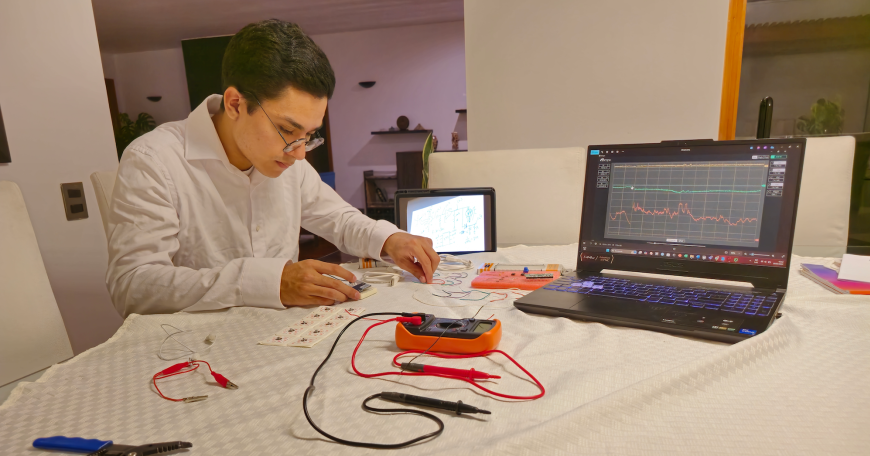
As a student working on a physics essay for the International Baccalaureate (IB) program, Pastor and his advisor were running experiments on muscle fatigue using electromyography (EMG) tools and troubleshooting inconsistent readings from the device they developed. He searched online for guidance, but most of what he found was unstructured and unspecific — until he discovered OpenCourseWare.
“It immediately felt different,” he says. “There was real lecture content and the kind of rigor that lets learners apply ideas instead of memorizing them.”
Materials from courses like Signals, Systems, and Inference; Biomedical Signal and Image Processing; and Circuits and Electronics helped Pastor gain skills and confidence as he pursued his research.
“These courses give motivated students a real path to learn at a serious level, with materials that respect their time and intelligence,” says Pastor, who is applying to colleges for the fall 2026 semester.
Understanding muscle fatigue has been a longtime interest for Pastor, who lived with his grandmother and witnessed her struggle with treatments and physical therapy to combat weakened muscles. In addition, Pastor competes in karting, a motorsport, and part of his training involved understanding how fatigue, muscular strain, and performance work under pressure.
“The connection between engineering and the human body is one of the reasons I'm so excited to keep studying these subjects,” Pastor says. “Elderly people, as well as people who practice sports or compete at high levels, can benefit from improving rehabilitation.”
When Pastor was in high school, he entered a startup competition sponsored by the Universidad San Ignacio de Loyola that allowed him to work directly with residents at an eldercare home. Pastor was the leader of a group of students who developed a small, portable EMG, with the goal of generating reliable readings that caregivers could translate into routines to preserve strength.
“Initially, I built a first prototype using electrodes, amplifiers, resistors, and other components on a breadboard,” he explains.
But performing these types of measurements required more precision than the prototype could manage.
“Before OpenCourseWare, that moment came with a quiet panic,” says Pastor of working with residents at the start of his project. “The waveform would appear, then wobble and drift. A small shift in the cable or a change in posture could flood the trace with noise. I had empathy and curiosity, but not enough technical clarity to say, with confidence, what the signal meant or how to make it reliable.”
Once he worked through the MIT resources, the shift was immediate.
“Interference stopped being a vague problem and became something I could identify, reduce, and explain,” he says. “I could justify circuit choices and tune gain and conditioning with purpose, then verify whether each change actually improved the trace.”
For Pastor, whose experience with his grandmother’s declining health makes the project personal as well as academic, gaining this knowledge was a huge triumph.
“I have seen how fragile independence can become, like when the body starts to fail, and how powerful measurement can be when it is done responsibly,” he says. “After OpenCourseWare, the EMG stopped feeling like a fragile demo and started feeling like a tool. The readings became stable enough to analyze and clear enough to explain, and I could focus on the human part again: listening well, documenting carefully, and building something that earns trust.”
This story was originally published on MIT Learn.