

A lifetime of perseverance, powered by MIT Open Learning
Looking back on his nearly two-decade journey from earning his bachelor's degree in Saudi Arabia to completing his PhD in Canada, Omar Alshehri has a message for MIT Open Learning: “Despite the fact that I still can’t properly pronounce ‘Massachusetts,’ thank you for being one of the hidden forces that kept me going throughout my own Battle of Waterloo.”
For many people, Waterloo refers to the hard-fought battle that led to the surrender of France’s Emperor Napoleon Bonaparte and the end of the 19th-century Napoleonic Wars. Since then, “meeting your Waterloo” has come to mean facing defeat.
For Alshehri, Waterloo represents a difficult battle, but one that ultimately saw him triumph.
After completing a bachelor's in industrial engineering at King Saud University in 2008, he started a master’s program in nanotechnology at University of Waterloo in Ontario, Canada. This was enough of a shift in focus that he realized he needed some additional support.
“I had forgotten the difference between a proton and a neutron,” Alshehri says. “I even remember calling a high school teacher in my village to get the answer.”
Reaching out to former teachers was a start, but he knew that he would need more robust resources if he wanted to build his technical knowledge. Enter MIT Open Learning’s OpenCourseWare, a library of resources from more than 2,500 MIT undergraduate and graduate courses. All are available online for free.
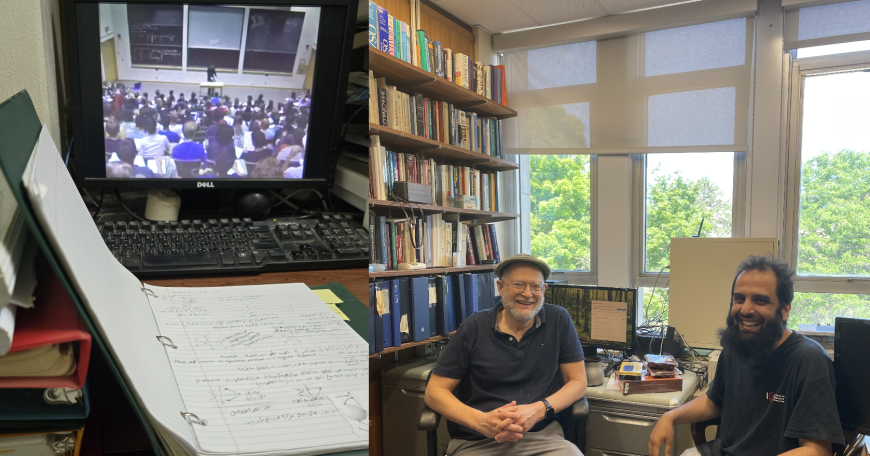
“I treated the OpenCourseWare courses as if I were a full-time student: I watched the lectures and wrote down everything by hand,” he says. “This effort resulted in a large pile of files that I still keep to this day, as I continue to use them when preparing my own lectures and book projects.” Alshehri explored resources on materials science, electronics, and quantum mechanics. He says they combined the best of an in-class experience with the benefits of studying online.
The way the classes were filmed made him feel like he was really in a classroom, watching the professor move around and seeing things from different angles. He remembers turning off the lights in his room and imagining himself sitting in the live lecture. Other online resources were simply slides and notes and didn’t capture his attention. At the same time, the online nature of the class allowed him to pause, take notes, and review as needed.
When he completed his master’s in 2012, it was time for another change — this time to quantum physics. It was an even bigger disciplinary shift than his last, and a bigger hurdle to clear. He met with faculty members across Europe and Canada before connecting with a new scientist at his alma mater, University of Waterloo, who was willing to take him on as a doctoral student at Waterloo’s Institute for Quantum Computing.
That professor, Alshehri says, “saw value in what others saw as a weakness: a mechanical engineering perspective within a quantum research group.”
Alshehri’s background became an advantage, enabling him to focus on the mechanical aspects that support quantum equations and to explore questions such as: What are the devices and machines with which quantum physics is realized?
He was eager to take on these questions, but first he had to face challenges like a quantum photonics and electronics course. The professor teaching the course, he says, was impressed with his ability to get through the material, given his engineering background.
“What he didn’t see was the 300 hours of online study, mostly through OpenCourseWare, that gave me the confidence to take this class,” Alshehri says.
Resources from courses like 6.002 Circuits and Electronics, 8.04 Quantum Physics I, and 6.003 Signals and Systems supported him through the challenges of his doctoral program, which included a late change to his research focus and personal and professional obstacles. All in all, it took him 12 years to complete his PhD.
Alsheri’s determination was so unwavering that University of Waterloo now honors him by offering the Dean of Engineering Doctoral Perseverance Award, inspired by his experience. The award criteria states, “Omar's journey exemplifies unwavering commitment, courage, and the resilience to thrive in the face of adversity, serving as an inspiration to our engineering community.”
Now done with his schooling, Alsheri is looking for his next step. He is working on a memoir that chronicles his educational journey.
“In my PhD thesis, I chose not to list the names of those who helped me, because it would have doubled the size,” he says. “In my memoir manuscript, I have acknowledged MIT Open Learning. I’d like to use this chance to do it again, on MIT’s own website. Thank you.”
Alshehri met his Waterloo many times as he worked toward his goal. With support from MIT Open Learning’s OpenCourseWare, he never faced defeat.
This article was originally published on MIT Learn.