

New MIT Open Learning video explores the scientific and social aspects of curiosity
By Stefanie Koperniak
“I am a lifelong learner,” said Bia Adams, a London-based neuropsychologist, therapist, and former professional dancer. “My career has been built across diverse experiences, but I think I’ve always retained an interest in lifelong learning. I like to say that if money and jobs were not concepts, I would happily be a forever student.”
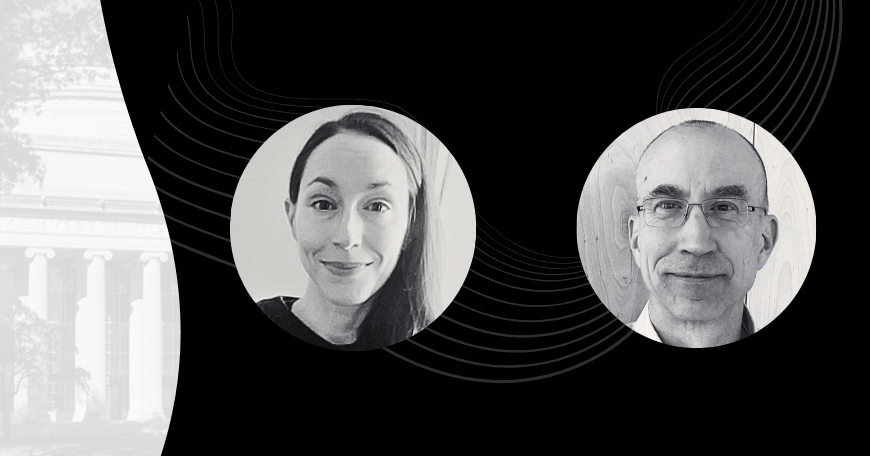
In a new Open Conversation, “Learning for Life: How Curiosity Shapes Well-Being,” Adams talks to Curt Newton, director of MIT OpenCourseWare at Open Learning, about how this sense of curiosity has fueled her educational and career journey — leading her to free MIT resources including MIT OpenCourseWare. Adams draws from her personal experiences and her neuropsychology background to discuss the importance and benefits of curiosity for all learners.
Adams started dancing beginning in early childhood and then studied clinical and cognitive psychology. She practiced as a psychologist for several years, before going on an extended sabbatical to explore dance again, studying at the London Contemporary Dance School and performing for a few years. She also earned a black belt in Aikido and started skateboarding and longboarding. After experiencing some injuries related to the latter, she resumed her studies in psychology, ultimately specializing in medical neuroscience. She now works as a neuropsychologist.
In 2022, Adams first discovered MIT OpenCourseWare, which offers free, online, open educational resources that span the MIT undergraduate and graduate curriculum. She has learned from courses in quantum physics, computer science, philosophy, and biology, and looks forward to exploring more classes in the future. She also enjoys learning different languages and finished writing her first book of fiction, Humans After All, to be released in 2026. She says that all of these efforts, beginning with her study of dance, have been rooted in curiosity.
“I’ve always been drawn by movement,” said Adams. “Through ballet, I learned to dissect movement, understand technique, understand time, learn how movement relates to music, and also the possibilities of expression that arise out of study, not just the series of steps.”
Adams said that she understands much more now, as a neuropsychologist, about how the brain works than she did in her earlier days of studying dance.
“I didn’t realize that I was activating the dopaminergic system in the brain, the reward system,” said Adams. “That’s something which makes you go after things. It opens the door to learning, and it also makes you a bit more cognitively flexible, so that you can adapt to learning…I think curiosity almost had a protective role, as well, as I shifted to working in neuroscience. I looked at the career change as an opportunity to explore something new and meaningful instead of interpreting it as a threat to my identity.”
Newton noted that many learners throughout the world engaging with MIT Open Learning programs express a similar feeling of identifying as an explorer.
“We’ve learned that they’re coming from a lot of different positions,” said Newton. “Some of them are educators trying to figure out how to teach more effectively. Many of them are independent learners. What we’ve heard from everyone is that the number one reason why they’re coming to these resources is because they have a fundamental curiosity.”
Adams confirmed that maintaining a curious approach to life and engaging often with new learning material can have several scientific benefits.
“Learning literally changes the brain,” said Adams. “It drives what we call neuroplasticity, the brain’s ability to change itself in response to experience, in response to new learning. Curiosity in new learning rewires the brain. You form new circuits, you allow for neurogenesis, the formation of new neurons in some areas of the brain, particularly the hippocampus. It also acts as a protective buffer against age-related cognitive decline.”
Adams also talked about how the important social and emotional aspects of learning, such as learning alongside others, can help to build motivation and provide some accountability, helping learners to work through obstacles. The support and opportunities for discussion can also build efficacy and confidence, all proven to reduce symptoms of anxiety, depression, and isolation.
Newton confirmed hearing stories from learners from around the world that echo these benefits and experiences.
“At OpenCourseWare, and at Open Learning as a whole, we hear from so many people that they’ve been able to make use of our resources, even if they’re living in complicated, disrupted situations,” said Newton. “People are able to tap into their resilience and foundational curiosities and continue to keep learning.”
MIT Open Learning’s Open Conversation series highlights how free access to MIT’s knowledge and educational resources can change lives, communities, and the world.
Watch the first two talks in the series:
- “Alleviating poverty and sharing knowledge globally with Esther Duflo”
- “How opening learning can close knowledge gaps with June Odongo”
New MIT Open Learning video explores the scientific and social aspects of curiosity was originally published in MIT Open Learning on Medium, where people are continuing the conversation by highlighting and responding to this story.