

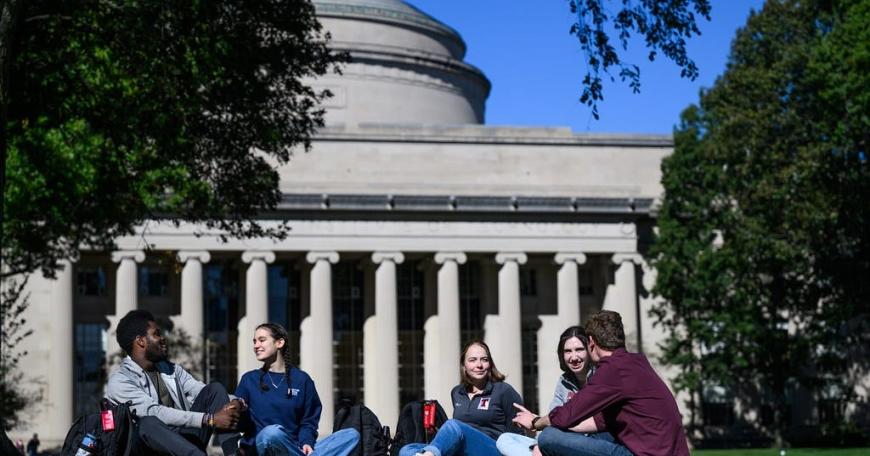
Perspective: Expanding MIT’s educational mission for the world
By Dimitris Bertsimas
The problems shaping our future don’t fit into neat boxes. Climate change isn’t just an environmental issue; it requires economics, policy, and human behavior expertise. Artificial intelligence isn’t only technical; it raises questions that span ethics, social justice, and the environment. Public health doesn’t stop at the doors of hospitals; it needs expertise in infrastructure, communication, and equity.
After nearly four decades of teaching at MIT, I’ve observed that the most important problems my students go on to face rarely announce themselves as belonging to a single discipline. They aren’t labeled “solve with computer science” or “apply business principles here.” Instead, they arrive as they truly are — technical and human, theoretical and practical, scientific and ethical all at once.
MIT has long been known for graduates who thrive in this complexity. They are exceptional thinkers, but more importantly, they are problem solvers trained to cross boundaries, synthesize ideas, and turn knowledge into action. This analytical, creative, and deeply pragmatic mindset is at the heart of what makes an MIT education distinctive. And this approach has never been more necessary.
Yet this transformative education reaches only a fraction of people who could benefit from it. That limitation has never felt right to me, and it’s what we have the opportunity to change.
At MIT Open Learning, the Institute’s home for online and digital learning, we’re launching Universal Learning, a new initiative to develop online curricula that prepares learners to take on complex global challenges. Universal Learning offerings combine MIT’s subject matter expertise and Open Learning’s more than 25 years of innovation in online education to deliver a learning experience that cultivates the interdisciplinary thinking that defines an MIT education.
The Universal Learning curricula span both theoretical foundations and practical applications of topic areas like AI, climate, energy, biology, and healthcare. We’ve designed it from the ground up for accessibility to a broad audience, with the material grounded in real-world stories and applications. Learners gain MIT-level expertise delivered in an approachable format. All Universal Learning offerings will be delivered on MIT Learn, the Institute’s new online learning platform.
This spring, we will launch Universal AI, the first offering in the Universal Learning portfolio. Artificial intelligence is a fitting starting point. It is a quintessential cross-disciplinary challenge, touching nearly every aspect of modern life while raising profound questions about work, ethics, and equity. In Universal AI, learners gain a shared language for understanding AI’s possibilities and limitations, from theoretical foundations to real-world applications across industries.
AI is not only the subject of study, it is also part of how learning happens. Through the AskTIM AI assistant, a suite of AI tools developed by MIT engineers and researchers for the MIT Learn platform, we are able to personalize the learning experience at scale in ways previously impossible. For example, within Universal AI, learners can use AskTIM to summarize lectures, reinforce key concepts with flashcards, and guide them through concepts, homework, and quizzes, offering the right nudge toward the next step without giving away the answers.
Later this year, Universal Learning will expand to include curricula in climate, energy, and biology, with other cross-cutting challenges like manufacturing and healthcare to follow.
The challenges ahead are immense, but so is the opportunity to educate learners across the world to think beyond traditional boundaries. With Universal Learning, MIT’s approach to educating those minds will reach beyond our campus walls — and in doing so, we’re expanding who will solve the world’s greatest challenges that affect us all.
Dimitris Bertsimas is the Vice Provost for Open Learning at MIT, the Associate Dean of Business Analytics, the Associate Dean of Online Education & Artificial Intelligence, the Boeing Leaders for Global Operations Professor of Management, and a Professor of Operations Research at MIT Sloan School of Management.
Perspective: Expanding MIT’s educational mission for the world was originally published in MIT Open Learning on Medium, where people are continuing the conversation by highlighting and responding to this story.