

Where are these open learners now?
At MIT Open Learning, the impact of open education can be seen in the journeys of more than 500 million learners around the world. Twenty-five years ago, that journey began with OpenCourseWare, a bold initiative to make MIT’s curriculum freely available to anyone, anywhere.
Today, OpenCourseWare is part of Open Learning and offers free materials from more than 2,500 MIT undergraduate and graduate courses — all discoverable on the MIT Learn platform. Learners across all seven continents have used these resources to transform their education and careers.
As part of Open Learning’s celebration of this milestone, we recently caught up with a few of these learners.
From a fledgling interest to a physics career
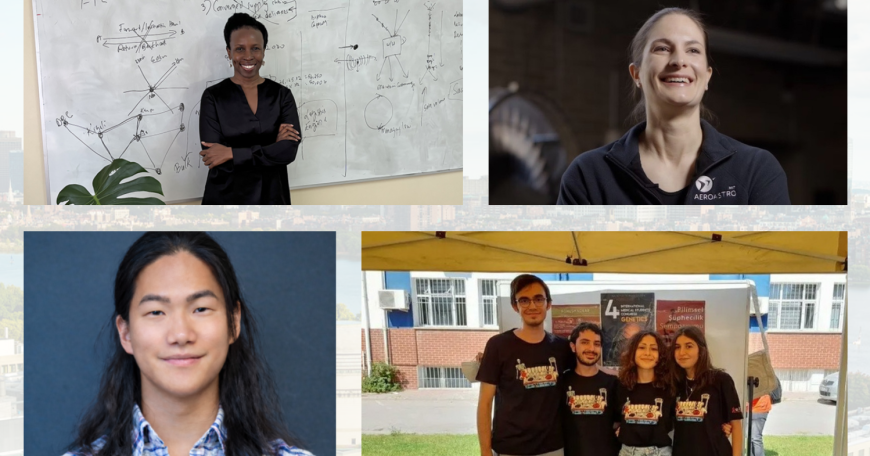
Kyle Lee took his first physics class in 2010 as a freshman at a community college in Orange County, CA. “I felt an immediate pull toward the subject, but I had little sense of what it truly meant — or what it would take — to become a physicist,” he recalls. That began to change after he searched online for guidance and discovered Open Learning’s OpenCourseWare.
Through mathematics and physics courses such as Classical Mechanics, Linear Algebra, and Multivariable Calculus, he says, “I was able to realize the wide gap between where I was as a budding scientist and where I needed to be to make my dream a reality.”
Lee is now an assistant physicist in the Theoretical Particle Physics Division at Argonne National Laboratory. With the knowledge and confidence he gained from MIT’s free educational resources, he transferred to a four-year university on a full scholarship. In 2020, he earned his PhD in theoretical physics from Stony Brook University, where he revisited OpenCourseWare for some of its more advanced offerings, such as Prof. Iain Stewart’s course in Effective Field Theory. He has held postdoctoral research positions at University of California, Berkeley, Yale University, and MIT’s Center for Theoretical Physics, where he says he was “working side by side with Iain and many other colleagues from MIT that I looked up to for many years.”
“Looking back, I’m struck by how unimaginable my current life would have seemed to me in 2010, when I first chose to become a physicist,” Lee says. “OpenCourseWare opened doors for me, giving me context for where I stood and direction for where I needed to go on my chosen path in life.”
Learn more about Lee’s story.
A research program of one’s own
When Yıldırım Adalıoğlu, Çağan Kaplan, Sıla Özkal, and Begüm Tahhan — recent graduates of the Ege University Faculty of Medicine in Turkey — first gathered to study Single Variable Calculus using OpenCourseWare resources, they’d wanted to strengthen their mathematics skills to pursue independent research while completing their medical degrees.
Five years later, the group, which the founders called İleri Çalışmalar (“Advanced Studies”), has grown into an independent, student-led research group. Members have completed projects at institutions in Turkey and abroad including the Institute of Pathology in Heidelberg, Germany, and published in peer-reviewed journals such as Epidemiologic Methods. What hasn’t changed is the group’s core curriculum, which includes MIT courses in single variable calculus, multivariable calculus, linear algebra, and probability and statistics, as well as introductory biology, chemistry, and biochemistry courses. The founders explain that they designed the curriculum to ensure that “everybody has the background to do research from a statistical perspective and the biological perspective to do multidisciplinary research.”
Though they’ve graduated, İleri Çalışmalar’s founders continue to be involved with the group — and to learn with OpenCourseWare materials. “Thanks to these resources, we have the space and connections to do research in our residency,” Adalıoğlu says. “I think what OpenCourseWare does is pretty amazing because it provides us with amazing theoretical resources, suggestions, and other things to do what we love to do — research.”
Learn more about İleri Çalışmalar’s story.
Building the foundation for success
In the first semester of her master’s degree program in aeronautics and astronautics at MIT, Andrea Henshall felt “very optimistic” and enrolled in Stochastic Estimation and Controls. “I did not do well,” she recalls, explaining, “I didn’t really recognize that I probably needed to brush up on some more theory.” Then her mentor told her about OpenCourseWare. In between semesters, she studied Prof. Gil Strang’s linear algebra courses and gained the background knowledge needed to complete her degree.
“MIT OpenCourseWare absolutely, 100% saved my master’s, and set me up for academic success,” says Henshall, who went on to complete a second master’s in computer science and software engineering at Auburn University.
A retired U.S. Air Force major, Henshall is now a PhD candidate in MIT’s Department of Aeronautics and Astronautics. Throughout her graduate studies, she has turned to OpenCourseWare any time she has needed to brush up on foundational knowledge. Before starting at Auburn, she studied Introduction to Algorithms and other computer science courses. To prepare for her PhD minor in quantum information, she dove into Quantum Mechanics and Quantum Information Science.
Henshall also mentors veterans transitioning out of the military into academia, working with nonprofit organizations like Service to School and the Warrior-Scholar Project (WSP) and sharing MIT’s educational materials with the service members she’s met. “Some of them are still deploying and working weird hours, so [resources] like OpenCourseware are the only way that they can [refresh or build this academic] experience,” she says. “I always hear great feedback about how helpful it was.”
Learn more about Henshall’s story.
Closing knowledge gaps
For June Odongo, “learning is a muscle.” The founder and CEO of Senga Technologies, a Kenya-based logistics software and services company, was the first guest on MIT Open Learning’s Open Conversation, a series that features people who have used Open Learning resources to improve their lives, empower members of their communities, and work toward change.
In 2022, when Odongo interviewed early-career electrical engineer Cynthia Wacheke for a software engineering position at Senga, she was impressed by Wacheke’s potential and eagerness to solve complex problems. Using OpenCourseWare, Odongo built a six-month “bridging course” to help bring Wacheke up to speed. The curriculum included nine courses: Introduction to Algorithms; Mathematics for Computer Science; Design and Analysis of Algorithms; Elements of Software Construction; Automata, Computability, and Complexity; Database Systems; Principles of Autonomy and Decision Making; Introduction to Machine Learning; and Networks.
Since then, the bridging course has become a way for Senga’s employees to close the knowledge gap, giving them the resources to realize their full potential in a competitive job market. Odongo, who first discovered OpenCourseWare as an undergraduate studying computer science, counts herself among the Senga employees who have more to learn. “We’re trying to apply technologies that have advanced significantly in the two decades since I’ve been out of school,” she says. “I actually go through my old curriculum and introduce new concepts on top of that. Learning has to be embedded in what we are trying to do.”
Learn more about Odongo’s story.
This article was originally published on MIT Learn.